
You know how sometimes even the strongest relationships hit that point where conversations feel a little… surface level? Maybe you talk about work, groceries, weekend plans but when it comes to deeper trust in relationships, it feels like something’s missing. It happens to everyone. Building trust in relationships doesn’t just magically appear; it grows from the way you communicate every single day.
I was reading up on this stuff a while back, and there are actually a bunch of exercises you can do. Not like cheesy trust falls, but real, practical things that can help you and your partner build a stronger bond. It’s all about creating a safe space where you can be vulnerable and understood.
In relationships, it’s crucial to engage in meaningful discussions that foster closeness and understanding.
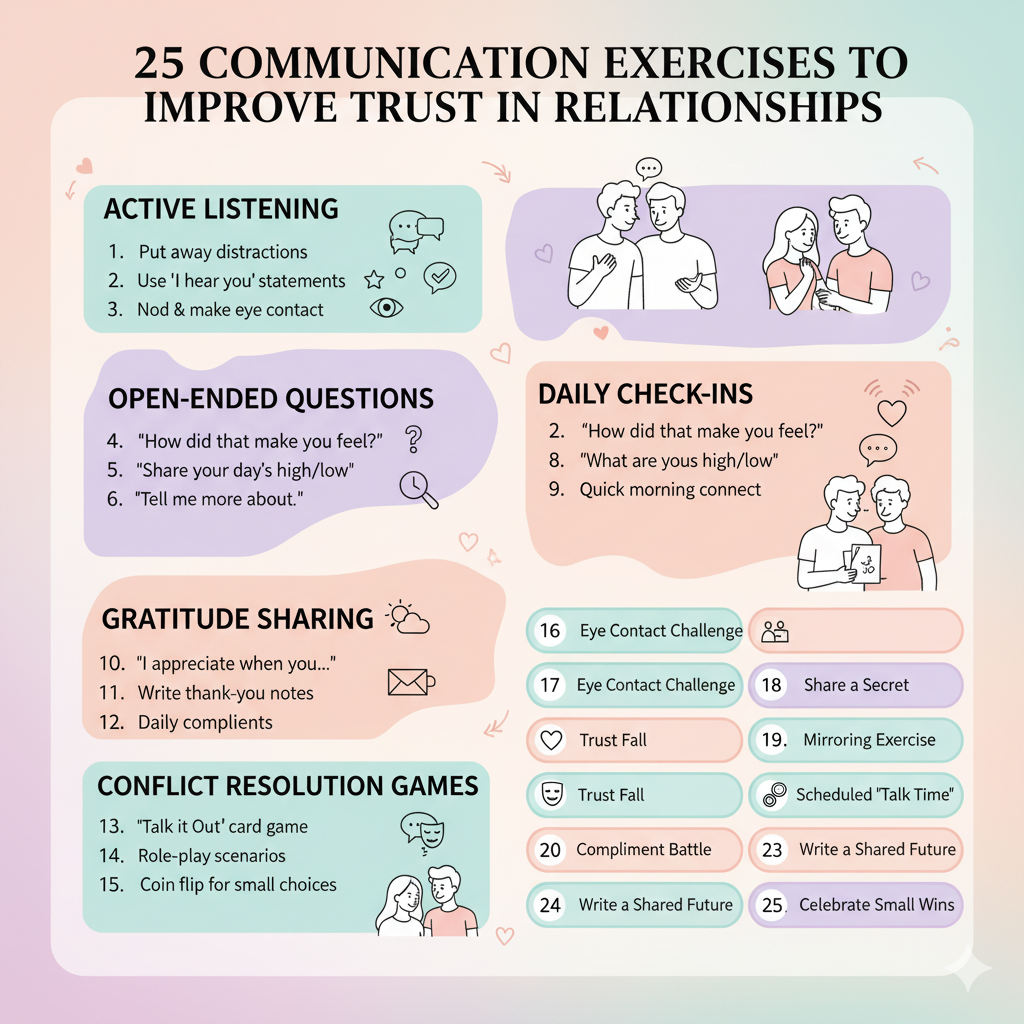
Building Trust in Relationships
Many of these exercises can ultimately strengthen the fabric of relationships.
Moreover, these exercises can help you and your partner deepen your relationships through shared experiences.
Practicing deep listening will enhance your relationships and create an environment of respect.
Think about it. We spend so much time communicating at work, with friends, and on social media, but we often neglect the most important conversations – the ones with our partners. We assume they know how we feel, what we need, and what we’re thinking. But that’s a dangerous assumption. Building trust isn’t a one-time thing; it’s a continuous process, a daily practice. It’s in the small moments, the shared silences, and the active listening.
Let’s talk about some of these. These aren’t just for couples in trouble; they’re for anyone who wants to deepen their connection and make their relationship even stronger. They’re like relationship maintenance, preventing those little cracks from becoming giant canyons.
Ultimately, effective communication is key to keeping relationships healthy.
The shared story exercise can bring you closer and enhance your understanding of relationships.
Asking deeper questions helps build trust in relationships.
Creating a no-distractions dialogue is essential for nurturing relationships.
Deep Listening: Beyond Just Hearing
We often think we’re good listeners, but true listening is a skill. It’s about putting your own thoughts on pause and giving your full, undivided attention to your partner. It’s not just waiting for your turn to talk; it’s about understanding their perspective, their feelings, their world.
The emotional check-in is a fantastic way to strengthen your relationships.
The “I Hear You” Exercise
This one is simple but powerful. When your partner is speaking, your only job is to listen. Don’t interrupt, don’t formulate your response, just listen. When they’re done, summarize what you heard. Start with, “What I hear you saying is…” This shows them you were truly listening and gives them a chance to clarify if you misunderstood. It removes the guesswork and builds a bridge of understanding.
The Shared Story
Take turns telling a story from your day, but with a twist. The listener has to ask clarifying questions only, not give advice or their own opinion. Questions like, “How did that make you feel?” or “What happened next?” This helps the speaker feel validated and the listener to gain deeper insight into their partner’s emotional landscape.
Vulnerability plays a crucial role in developing trusting relationships.
The No-Distractions Dialogue
Sharing fears and hopes can transform relationships for the better.
Using the “I feel” statements can significantly clarify feelings in relationships.
Set aside 15-20 minutes with no phones, no TV, no other distractions. Just sit face-to-face. One person speaks about a topic of their choosing for five minutes while the other listens without interruption. Then, switch roles. This dedicated time creates a sacred space for connection.
Engaging in gratitude exchanges helps reinforce positive aspects of relationships.
The Emotional Check-In
At the end of each day, ask each other, “How are you really doing?” and “What was the best and worst part of your day?” This opens up a channel for emotional intimacy and prevents small issues from festering.
Conflict resolution is a vital skill that affects all relationships.
“The biggest communication problem is we do not listen to understand. We listen to reply.” – Stephen R. Covey
Following conflict rules can enhance the quality of your relationships.
“The biggest communication problem is we do not listen to understand. We listen to reply.” – Stephen R. Covey
Vulnerability and Transparency: Sharing Your Inner World
Asking how you can help is a significant part of maintaining healthy relationships. Trust thrives in an environment of vulnerability. It’s about being brave enough to show your true self, imperfections and all, and knowing your partner will accept you.
The Fear and Hope Share
Sit down and each of you write down one fear you have and one hope for the future. It could be about your relationship, your career, or anything. Then, share them with each other. This is a profound exercise in vulnerability and can lead to powerful conversations about your shared future.
The “I Feel” Statements
Instead of saying, “You always make me feel…”, which can sound accusatory, try starting with “I feel…” For example, “I feel hurt when I am not heard” instead of “You never listen to me.” This shifts the focus from blame to personal feelings and opens the door for a more productive conversation.
The Gratitude Exchange
Each day, or a few times a week, share one thing you are grateful for about your partner. Be specific. “I appreciate how you took the time to make me coffee this morning” is more impactful than “I’m grateful for you.” This reinforces positive behaviors and reminds you both of the good in your relationship.
Navigating Conflict with Grace: The Path to Resolution
Arguments are inevitable, but they don’t have to be destructive. They can be opportunities to understand each other better. The key is to fight fair and remember you are on the same team.
The Conflict Rules
Before a big argument, set a few ground rules. For example, “We won’t use insults,” “We won’t bring up past issues,” and “We will take a break if things get too heated.” This keeps the conversation from spiraling out of control.
The Repair Attempt
In every relationship, commitment to growth is essential for long-term success. Ultimately, the effort you put into your relationships can lead to deeper connections.
During or after an argument, one person can make a “repair attempt” – a statement or action to de-escalate the tension. This could be a joke, a simple “I’m sorry,” or a hug. It’s a way of saying, “I value our relationship more than this fight.”
The “What Can I Do?” Question
When your partner expresses a problem or concern, instead of getting defensive, ask, “What can I do to help?” or “What do you need from me right now?” This shifts the dynamic from a battle to a team-based problem-solving session.
Schedule a “Relationship Tune-Up” once a month. This isn’t a therapy session, but a chance to check in on your relationship’s health. Talk about what’s working well, what could be better, and what you’re looking forward to. This proactive approach prevents issues from building up.
Schedule a “Relationship Tune-Up” once a month. This isn’t a therapy session, but a chance to check in on your relationship’s health. Talk about what’s working well, what could be better, and what you’re looking forward to. This proactive approach prevents issues from building up.
Building Fun and Connection: The Lighter Side of Communication
Communication isn’t always about serious conversations. It’s also about having fun, laughing together, and creating new memories.
The “What If” Game
Ask each other fun, hypothetical questions. “What if we won the lottery?” “What if we could travel anywhere tomorrow?” This sparks creativity and gives you insight into your partner’s dreams and desires.
The Compliment Box
Each person writes down a few compliments for the other on small slips of paper. Put them in a box. When one of you is feeling down, you can pull a compliment out. It’s a small, tangible way to show your appreciation.
Shared Hobbies
Take up a new hobby together. Whether it’s cooking, hiking, or learning a new language, this shared experience creates a new space for communication and teamwork outside of your normal routine.
Final Thoughts
Look, man, relationships are a marathon, not a sprint. The strongest ones aren’t perfect; they’re the ones where both partners are committed to putting in the work, to communicating openly, and to treating each other with kindness and respect. These exercises are just tools. The real magic happens when you use them consistently and with a genuine desire to connect.
So, how about you and Sarah try one of these this week? Maybe start with something simple, like the “I Hear You” exercise. It’s a small step, but it could make a huge difference.
Leave a Reply